You used to make mates without thinking about it. Now you have to think about it. Here's how.
At school, friendships happened by proximity. You sat next to someone for a year and they became your best mate. At uni or on the tools, you had a built-in cohort — people your age, doing the same thing, at the same time, five days a week. Friendships formed almost by accident.
Then you hit your 30s. You got busy. Career, mortgage, partner, kids, the never-ending weekend sport-and-Bunnings loop. Your social circle started shrinking and you barely noticed, because the people who remained — your partner, maybe one or two old mates, your work colleagues — felt like enough.
By your 40s or 50s, the maths has shifted. Over half of Australian adults say their number of close friends has decreased, and half of those who've tried making new friends say it's become harder in recent years. A third of Australian men aged 35 to 50 meet the criteria for loneliness. And here's the kicker: having fewer friends, lacking close male friendships, and having limited opportunities for social interaction have all been consistently associated with increased loneliness in men.
This isn't a feelings piece. It's a practical guide to doing something about it.
Why It Got Hard
Understanding why adult male friendships atrophy helps you fix the problem rather than just feeling guilty about it.
The proximity engine switched off. School, sport, uni, early career — all of these forced you into repeated, unstructured contact with the same people. That's the exact recipe for friendship formation: regularity, shared experience, and time. Once you leave those environments, nothing replaces them automatically.
Your social needs got outsourced. Many blokes — particularly those in long-term relationships — gradually channel all their emotional and social needs through their partner. That works until it doesn't. Relationship breakdown, bereavement, or even just the slow erosion of having no one to talk to except the person you live with puts enormous strain on both of you.
The "initiative gap" widened. Making a friend as an adult requires someone to make the first move, suggest the second catch-up, and tolerate the awkwardness of early-stage friendship. Most blokes would rather chew glass than text another bloke "hey, want to grab a coffee?" without a clear practical reason. From a young age, boys are often taught to suppress emotion and avoid behaviours perceived as weak, and these patterns persist into adulthood, eroding emotional literacy and blocking the development of meaningful male friendships.
Cost of living squeezed socialising. Two in five Australians go out less due to the cost of living, and close to one in five avoid social plans altogether due to cost. When catching up with a mate means $25 pints at the pub, it's easy to let months slip by.
The Practical Playbook
Here's what actually works, stripped of the self-help fluff.
1. Join something with a regular schedule
This is the single most effective strategy, and it works for the same reason school friendships worked: repeated, low-stakes contact with the same people over time. The activity itself almost doesn't matter — what matters is that you show up consistently and it involves other humans.
Options that work well for blokes in Australia and New Zealand:
Parkrun — free, every Saturday morning, 5km run or walk at your local park. The run itself takes 20–30 minutes, but the post-run coffee is where the friendships form. There are over 450 Parkrun locations across Australia and it's genuinely one of the best community on-ramps going. You don't need to be fit. You need to show up three weeks in a row.
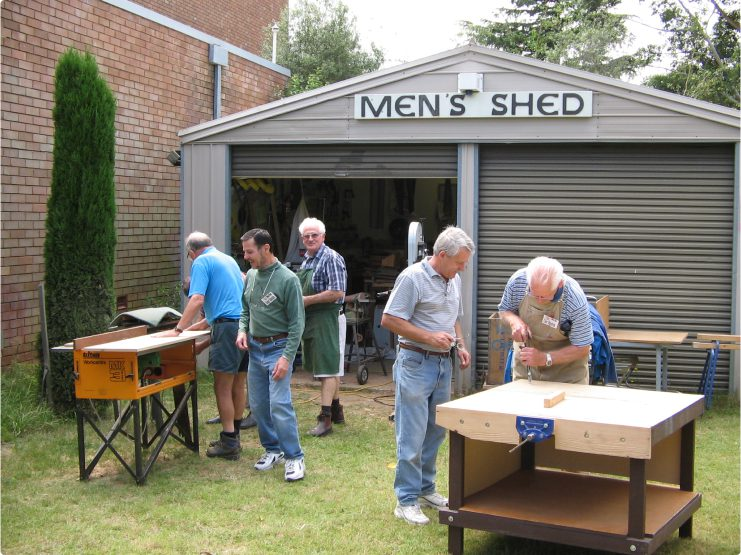
Men's Shed — over 1,000 locations across Australia and growing in New Zealand. The model is simple: blokes gather in a workshop, work on projects (woodwork, metalwork, repairs, community builds), and talk while they do it. These sheds provide a supportive environment for men to connect informally and purposefully, without the pressure of forced emotional discussions. By doing something together, the walls come down naturally. Progressivepsychology
Team sport or social leagues — touch footy, futsal, cricket, lawn bowls, social tennis. The competition is a vehicle; the real point is the beer afterwards. Most cities and towns have social leagues specifically designed for blokes who haven't played since their twenties.
Gym, CrossFit, F45, or a martial arts club — anything with a class structure where you see the same faces three times a week. The shared suffering of a hard session is a remarkably efficient bonding mechanism.
Volunteering — surf lifesaving clubs, rural fire brigades, community gardens, coaching kids' sport. Research shows that for older men specifically, volunteering is an important factor in decreasing loneliness. It also gives you an identity beyond work and family.
2. Be the one who initiates
Most blokes are waiting for someone else to make the first move. Which means everyone's waiting and nobody's moving. The uncomfortable truth is that if you want more friendships, you need to be the one who sends the text, suggests the catch-up, and follows through.
Start small. "Hey, want to grab a coffee after Parkrun?" "A few of us are watching the footy on Saturday — you keen?" "I'm heading to the driving range Thursday arvo if you want to come." The ask doesn't need to be deep. It needs to be specific (day, time, activity) and easy to say yes to.
The rule of three applies: most new friendships need at least three one-on-one interactions before they start to feel natural. The first one is always slightly awkward. Push through it.
3. Lower the bar for what "catching up" looks like
If every catch-up requires a restaurant booking, a babysitter, and a Saturday night, it's not going to happen often enough to build anything. The friendships that actually stick are built on low-effort, high-frequency contact.
Walk the dog together. Grab a takeaway coffee. Do a hardware store run. Watch a game on the couch. Go fishing and barely talk for three hours. The activity is a scaffold for the conversation — it doesn't need to be an event.
Over 30% of Australians are now choosing more low-cost or free activities for socialising. That's not a compromise — it's actually a better model for friendship. The $8 long black at the park builds more connection than the $200 dinner you do once a year.
4. Invest in the friendships you already have
Before chasing new connections, audit the ones you've let slide. Most blokes have two or three old mates they haven't spoken to in months — not because anything went wrong, but because nobody picked up the phone. That's fixable in thirty seconds.
Send the text. Make the call. Don't apologise for the gap — just re-engage. "Haven't caught up in ages — how's things?" works fine. Having access to good quality and supportive social relationships — including friendships — is protective against loneliness at every adult life stage. The quality matters more than the quantity. Two or three solid mates you actually talk to is worth more than twenty acquaintances you see at barbecues.
5. Get comfortable with the awkwardness
Here's the part nobody tells you: making friends as an adult feels weird because it is weird. You're essentially asking another human to spend discretionary time with you, and that's a mildly vulnerable thing to do — especially for blokes who've been socialised to keep things casual and never appear needy.
The awkwardness is normal. It doesn't mean you're doing it wrong. It means you're doing something that most people want to do but are too self-conscious to try. The bloke you invite for a beer is probably just as relieved as you are that someone made the effort.
The Compound Effect
Friendships in your 30s, 40s, and 50s don't form like they did at school. They form slower, they require more deliberate effort, and they look different — less hanging out for hours, more structured catch-ups that fit around the rest of your life.
But they compound. One regular commitment leads to one or two familiar faces. A few coffees lead to a genuine connection. A genuine connection becomes the bloke you call when things get hard — or the bloke who calls you.
Frequent social connection, having a romantic partner, and high neighbourhood satisfaction are all protective against loneliness. You can't control all of those. But you can join something, show up consistently, and be the one who sends the text.
That's the whole strategy. The rest is just turning up.