"I Don't Snore, So It Can't Be Sleep Apnoea"
Why that's one of the most common — and potentially dangerous — assumptions in men's health, and why a sleep study might be the most important test you've never had.
The Story You Tell Yourself
It usually goes something like this: you're tired. Not just "long week" tired — deeply, persistently tired. You wake up feeling unrefreshed. Your concentration is shot by 2pm. You're irritable. Maybe your blood pressure has crept up and your GP can't quite explain why. Your partner says you sleep fine. You don't snore — or at least, nobody's told you that you do.
So you chalk it up to stress. Work. Kids. Life. And you keep going.
Here's the problem: obstructive sleep apnoea remains severely undiagnosed PubMed Central, and one of the biggest reasons is that most people — including many doctors — still picture the "classic" patient: an overweight, older man who snores like a freight train. If you don't fit that picture, it gets missed.
What Sleep Apnoea Actually Is
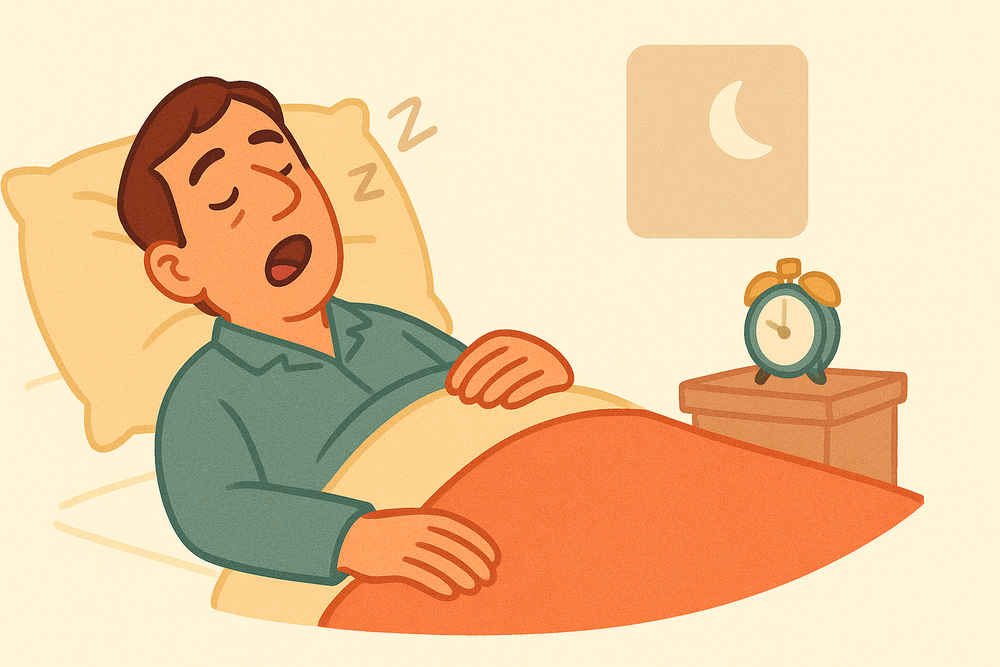
Obstructive sleep apnoea (OSA) occurs when the muscles in your throat relax during sleep and partially or completely block your airway — repeatedly, throughout the night. Each blockage can last 10 seconds or more, and it can happen dozens or even hundreds of times per night.
Every time it happens, your brain briefly wakes you up (often so briefly you don't remember it) to reopen the airway. The result: your sleep is fragmented at a level you're not consciously aware of. You clock 7–8 hours in bed, but the quality of that sleep is terrible. Your body never gets the deep, restorative sleep it needs.
And it's extraordinarily common. At an apnoea-hypopnoea index (AHI) of 5 or more events per hour, the overall population prevalence ranged from 9% to 38%, and was higher in men PubMed. One US estimate suggests OSA affects 34% of men PubMed Central. That's roughly one in three. Most don't know they have it.
Why "I Don't Snore" Doesn't Rule It Out
Although the complaint of snoring is commonly considered a cardinal feature of sleep apnoea, there is little objective evidence to support this self-reported observation Journal of Clinical Sleep Medicine. When researchers objectively measured snoring using acoustic analysis and machine learning, they found that there is only a weak positive correlation between snoring frequency and the severity of obstructive sleep apnoea, with substantial overlap across severity categories Journal of Clinical Sleep Medicine.
In plain language: some people with severe OSA barely snore. Some prolific snorers don't have OSA at all. Snoring is a poor predictor — and absence of snoring is an even poorer way to rule it out.
There's also a condition called upper airway resistance syndrome (UARS) — essentially the milder end of the same spectrum. Upper airway resistance, manifested as snoring without frank apnoea or hypopnoea events, and episodic flow limitation terminating in arousals, may represent the earliest stages of OSA Perelman School of Medicine. People with UARS often don't snore, don't desaturate on oximetry, and have a normal-looking AHI — but they have enough airway resistance to fragment their sleep and produce the same daytime symptoms: fatigue, brain fog, unrefreshing sleep, and mood disturbance. Standard home sleep tests can miss it entirely. It often requires a more detailed study to pick up.
Why This Matters More Than You Think
This isn't just about being tired. Untreated OSA is an independent risk factor for serious cardiovascular disease. A meta-analysis of prospective cohort studies found that severe OSA was associated with a 79% increased risk of cardiovascular disease, and more than double the risk of stroke, compared to those without OSA International Journal of Cardiology.
OSA is highly prevalent in patients with cardiovascular disease, estimated to occur in more than 40% of such patients PubMed Central. Among those with hypertension, coronary artery disease, or heart failure, it's estimated that 40–80% have OSA Sleepless in Arizona. And in patients with OSA and coronary artery disease, 56% of those inadequately treated developed further coronary disease compared to only 6.7% of those treated appropriately American College of Cardiology.
Beyond cardiovascular risk, untreated OSA is linked to:
- Resistant hypertension (blood pressure that won't respond to medication)
- Type 2 diabetes and insulin resistance
- Increased risk of motor vehicle accidents
- Depression and cognitive decline
- Reduced testosterone levels in men (which further compounds fatigue, mood, and body composition issues)
If you're a man in your 30s or 40s who's been told your fatigue is "just stress" or your blood pressure is "a bit high but nothing to worry about" — and nobody has ever asked about your sleep — that's a gap worth closing.
What a Sleep Study Actually Involves
There are two main options:
Home sleep test (Level 3): A small device you wear overnight at home that measures airflow, breathing effort, oxygen levels, and sometimes body position. It's convenient and picks up moderate-to-severe OSA well. It can miss milder cases and UARS.
In-lab polysomnography (Level 1): The gold standard. You sleep overnight in a sleep lab while brain waves, eye movements, muscle activity, heart rhythm, airflow, and oxygen are all monitored. It picks up everything — including the subtle arousals and flow limitations that home tests miss.
For most people, a home test is a reasonable starting point. But if your symptoms are significant and a home test comes back "normal," that doesn't necessarily mean you're fine — it may mean you need the more detailed in-lab study, particularly if UARS is suspected.
The Bottom Line
If you're sleeping 7–8 hours and waking up feeling like you've slept 4, something is wrong — and it's probably not just stress. If your blood pressure is creeping up without a clear explanation, if your concentration and mood have deteriorated, if you're relying on caffeine to get through the afternoon — these are all signals worth investigating.
You don't need to snore. You don't need to be overweight. You don't need to be over 50. One in three men has OSA, and the majority don't know it.
A sleep study is a single night of monitoring. What it can uncover — and what treating it can change — is genuinely life-altering for men who've spent years blaming themselves for being tired.
Ask your GP about a sleep assessment. It might be the best thing you do for your health this year.
This article provides general health information and is not a substitute for individualised medical advice. If you're experiencing significant fatigue, unrefreshing sleep, or unexplained changes in blood pressure or mood, speak with your doctor about whether a sleep assessment is appropriate for you.