You weren't a hyperactive kid. You did alright at school. So why can't you finish anything now?
You're 38. Maybe 42. You're not stupid — you know that. You've held jobs, raised kids, kept it mostly together. But something's off and it's getting harder to ignore.

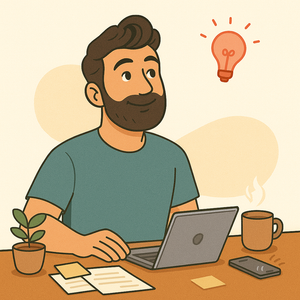
You sit down to do the BAS and an hour later you've reorganised your desk, replied to six texts, and googled whether it's worth getting solar panels. The BAS is untouched. Your partner says you never listen. Your boss has started CCing your manager on emails because things keep slipping. You've got seventeen tabs open in your browser and three half-read books on the nightstand.
You're not lazy. You're not careless. But you're starting to wonder whether your brain works a bit differently from everyone else's.
Here's the thing: you might be right.
The Bloke Who Slipped Through the Net
ADHD isn't what most of us picture. The hyperactive seven-year-old bouncing off walls in a classroom — that's the stereotype. And for decades, it meant boys who looked like that got picked up early, and everyone else got missed.
Adult ADHD affects somewhere between 2 and 5 percent of the adult population worldwide. In Australia, around 6 in 100 adults are estimated to have it. But here's the kicker: about 40 percent of men with ADHD don't get diagnosed until adulthood — and for many, "adulthood" means their late 30s or 40s, when the scaffolding that held them together finally starts to creak.
That scaffolding looks different for everyone. Maybe it was a structured school environment. A partner who kept the household running. A job that was stimulating enough to hold your attention. Maybe you were smart enough to compensate — to brute-force your way through exams, to pull all-nighters before deadlines, to survive on adrenaline and last-minute saves.
Then life got more complex. More kids, more responsibilities, more plates to spin. And the strategies that worked at 25 stopped working at 40.
If that sounds familiar, you're not alone. And you're not broken.
What Adult ADHD Actually Looks Like
Forget the kid in the classroom. In a grown man, ADHD tends to show up as a pattern of things that individually seem minor but collectively grind your life down.

Your attention is interest-driven, not importance-driven. You can spend four hours deep in a YouTube rabbit hole on the history of the SR-71 Blackbird but can't sit through a 20-minute team meeting without zoning out. That's not laziness — it's a neurological wiring issue around dopamine regulation. Your brain chases novelty and reward, not obligation.
You're time-blind. You genuinely believe a task will take ten minutes when it takes an hour. You're chronically late — not because you don't care, but because your internal clock is unreliable. Your mates have learned to tell you the BBQ starts at 12 when it actually starts at 1.
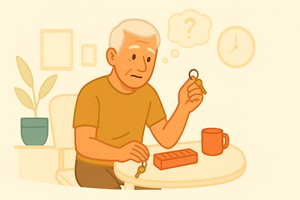
Your working memory is a sieve. You walk into Bunnings knowing exactly what you need and walk out with a new drill, a bag of potting mix, and no memory of the thing you actually came for.
Emotional regulation is hard. You go from calm to furious in a heartbeat when someone cuts you off in traffic. You feel things intensely, react fast, and then feel stupid about it ten minutes later. This one's under-recognised in men — it gets called a "short fuse" or "anger issues" rather than what it actually is.
You start things but don't finish them. The garage is full of half-done projects. You've signed up for courses you never completed. You've got a graveyard of abandoned hobbies — guitar, woodworking, that home brew kit — each one pursued with intense enthusiasm for about three weeks.
Sound like someone you know?
"But I Did Fine at School"
This is the line that trips people up. The assumption is that if you had ADHD, someone would have noticed. But that's not how it works for a lot of blokes.
If you were bright, you could compensate. If your school was structured enough, the external scaffolding did the work your executive function couldn't. If you were the inattentive type rather than the hyperactive type — the kid staring out the window rather than disrupting the class — you were invisible to the diagnostic radar.
For a formal ADHD diagnosis, symptoms need to have been present before age 12. But "present" doesn't mean "noticed." It means they were there — even if no one, including you, recognised them at the time.
Think back. Were you the kid who always left assignments to the last night? Who lost things constantly? Who could read a whole page and retain nothing? Who daydreamed through maths but could talk about dinosaurs for three hours straight?
That's what the psychiatrist will be looking for.
How to Actually Get Diagnosed in Australia
The pathway is straightforward in theory, less so in practice.
Step 1: See your GP. Tell them you think you might have ADHD. They'll do a general assessment, rule out other things that can mimic ADHD symptoms — thyroid issues, sleep disorders, depression, anxiety — and write you a referral. Ask for a referral under MBS Item 291, which gives you the best Medicare rebate for a specialist appointment.
Step 2: See a specialist. In Australia, a psychiatrist can both diagnose ADHD and prescribe medication. A psychologist can diagnose but can't prescribe — you'd need to go back to a psychiatrist or your GP for that. Expect 1 to 3 sessions of 45 to 90 minutes each. They'll do a clinical interview, run standardised questionnaires, ask about your childhood, and rule out other conditions.
The reality check: Private psychiatrist wait times are currently 2 to 6 months in most capital cities. Telehealth providers are faster — often 2 to 8 weeks — and the diagnosis is equally valid. Public mental health services can take 6 to 12 months or more, and often prioritise younger patients.
Cost: Initial psychiatric assessments typically run $500 to $850, with a Medicare rebate of roughly $250 to $430. Out-of-pocket, you're looking at $170 to $570 depending on the provider and your state. Queensland has recently started allowing specialist GPs to diagnose and prescribe for adult ADHD — the first state to do so — and other states may follow.
It's not cheap and it's not fast. But it's worth it.
Treatment: The Full Toolkit
Here's what a lot of people get wrong about ADHD treatment: they think it's just medication. Medication matters — a lot — but it's one part of a bigger picture. Think of it less like taking a painkiller and more like putting on glasses. The glasses help you see, but you still have to learn to read.
Medication
The two main classes are stimulants and non-stimulants.

Stimulants — methylphenidate (Ritalin, Concerta) and dexamfetamine (Vyvanse) — are the first-line treatment and the most effective for most people. They work by increasing dopamine and norepinephrine in the prefrontal cortex. The name is misleading — they don't amp you up, they help your brain regulate attention the way it's supposed to. Most people describe the effect as "quiet." Like the mental noise just… settles.
Non-stimulants — atomoxetine (Strattera) and guanfacine (Intuniv) — are options if stimulants don't suit you, or if there are concerns about cardiovascular issues, anxiety, or substance use history. They take longer to kick in (weeks rather than hours) but work well for some people.
All Schedule 8 stimulant prescriptions in Australia require authority from your state health department. Your psychiatrist or GP handles this — but it's worth knowing that the process exists, because it can add a step to getting your script filled.
Psychology and CBT
A psychologist — ideally one experienced in adult ADHD — can help you with the stuff medication doesn't fix. That includes building organisational systems, managing emotional reactivity, addressing the shame and self-criticism that comes from years of underperforming without understanding why, and tackling comorbid anxiety or depression, which affect roughly half of adults with ADHD.
Cognitive Behavioural Therapy adapted for ADHD is the best-studied psychological approach. It targets the practical deficits — time management, task initiation, prioritisation — and the negative thought patterns that build up over decades of struggling. You get 10 Medicare-subsidised psychology sessions per year under a Mental Health Treatment Plan from your GP.

ADHD Coaching
This one's less well known but increasingly evidence-supported. An ADHD coach isn't a therapist — they're more like a personal trainer for your executive function. They work with you on concrete, day-to-day strategies: building routines, breaking projects into steps, creating external accountability systems, and figuring out what actually works for your brain.
Research shows coaching improves executive functioning, goal attainment, and self-determination in adults with ADHD, with effects that hold up over time. It's particularly useful once the diagnosis dust has settled and you're past the "now what?" phase. Coaching isn't covered by Medicare, but many coaches work via telehealth and some offer sliding-scale fees.
The sweet spot for most people is medication plus either psychology or coaching — or both. Medication turns the volume down on the noise. Psychology and coaching teach you how to work with the brain you've actually got.
The Bit No One Talks About
Getting diagnosed in your late 30s or 40s is a strange experience. There's relief — finally, an explanation. There's grief — for the years you spent thinking you were lazy, or careless, or just not trying hard enough. And there's anger — at the system that missed you, at the people who told you to just try harder, at yourself for not figuring it out sooner.
All of that is normal. Sit with it.
Then do something with it. Because the data is clear: treated ADHD has dramatically better outcomes than untreated ADHD — in relationships, at work, in mental health, in basically every domain that matters.
You're not too old. You haven't left it too late. And the fact that you're reading this probably means the scaffolding is starting to creak.
Go talk to your GP.
ADHD is a neurodevelopmental condition, not a character flaw. If you recognise yourself in this article, it's worth having the conversation with a health professional. The clarity on the other side is worth the wait.