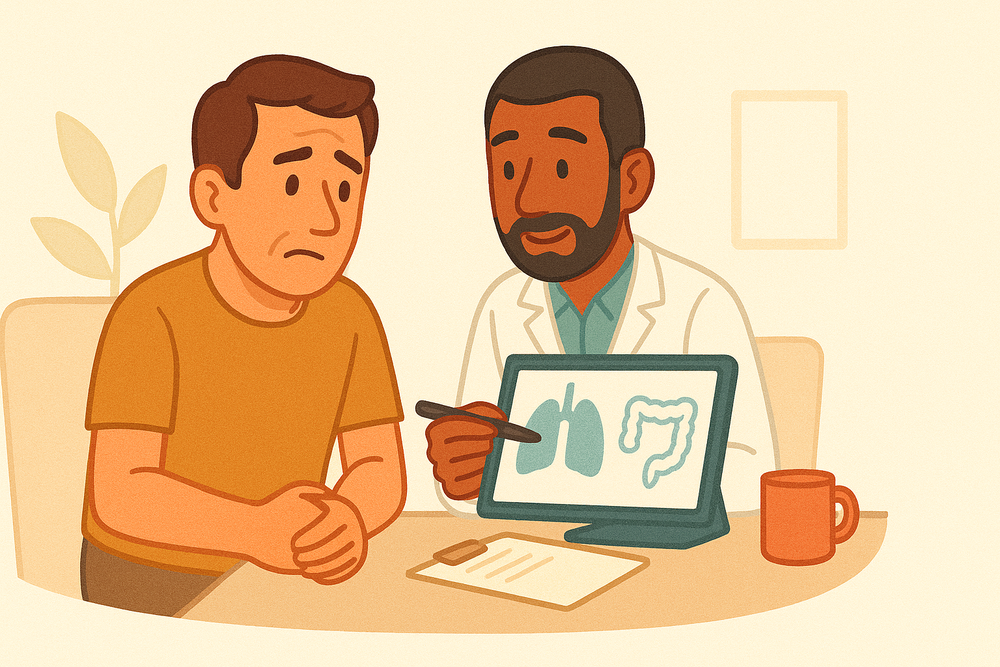
Cancer Screening for Men Across the Age Span: A Quick Overview
What the guidelines recommend, what they miss, and what's emerging beyond the standard playbook.
The Standard Playbook
Population-level cancer screening guidelines are designed to catch the cancers most likely to kill men, at the stage where early detection actually changes outcomes. The major bodies — USPSTF, ACS, NCCN — don't always agree on the details, but the broad strokes for average-risk men look like this:
Colorectal cancer is the third leading cause of cancer death in men. The USPSTF recommends screening all adults aged 45 to 75, with the option to screen selectively from 76 to 85 US Preventive Services Taskforce. Options include stool-based tests (FIT annually, or stool DNA every 1–3 years) or structural exams (colonoscopy every 10 years, CT colonography every 5 years). Incidence in the 40–49 age group has been rising — increasing by almost 15% from 2000–2002 to 2014–2016 US Preventive Services Taskforce — which is why the start age dropped from 50 to 45.
Prostate cancer screening is more nuanced. The USPSTF recommends that men aged 55 to 69 make individual decisions about PSA-based screening after a shared decision-making conversation about benefits and harms US Preventive Services Taskforce. Screening is not recommended routinely for men 70+. The key tension: PSA screening detects cancers that would never have caused symptoms, leading to overdiagnosis and potentially unnecessary treatment with significant side effects — about 1 in 5 men who have prostate surgery experience urinary incontinence, and about 2 in 3 experience erectile dysfunction CDC.
Lung cancer screening applies to a specific high-risk population. The USPSTF recommends annual low-dose CT for adults aged 50 to 80 with a 20 pack-year smoking history who currently smoke or quit within the past 15 years US Preventive Services Taskforce. This is the only screening with a clear mortality reduction demonstrated in large RCTs.
Skin cancer has no USPSTF-recommended population screening programme (evidence is rated as insufficient), but clinical skin checks remain standard practice in Australia and NZ given our UV environment. Annual full-body skin checks by a trained clinician are widely recommended locally, especially for men with fair skin, outdoor occupational exposure, or a history of sunburns.
The Summary Table
| Cancer | When to Start | Test | Frequency | Notes |
|---|---|---|---|---|
| Colorectal | Age 45 | FIT, stool DNA, or colonoscopy | Annual (FIT), every 10yr (colonoscopy) | Universal — all average-risk men |
| Prostate | Age 55 (consider 40–50 if high risk) | PSA ± DRE | Shared decision-making | Discuss benefits/harms; family history and African descent increase risk |
| Lung | Age 50 | Low-dose CT | Annual | Only if ≥20 pack-year smoking history + current/quit <15 years |
| Skin | Any age (AU/NZ context) | Clinical skin exam | Annual | Higher priority with fair skin, UV exposure, family history |
| Testicular | Adolescence–35 | Self-exam / clinical awareness | No formal programme | Peak incidence 20–35; no evidence for population screening |
What the Guidelines Don't Cover — And Where Longevity Medicine Steps In
Population screening guidelines are designed for average-risk people at the population level. They're deliberately conservative — they need to demonstrate that screening a million people does more good than harm in aggregate. That's the right framework for public health policy, but it's not necessarily the right framework for an individual who wants to be proactive about early detection.
Here's where the landscape is evolving:
Whole-body MRI is gaining traction as a comprehensive screening tool. Modern diffusion-weighted MRI protocols can detect solid organ tumours, lymphadenopathy, and metastatic disease without ionising radiation. The evidence base is still maturing — there are no completed RCTs demonstrating mortality reduction from whole-body MRI screening — but early data from centres like the Ezra and Prenuvo programmes shows detection of clinically significant incidental findings in a meaningful percentage of asymptomatic individuals. The main risks are false positives and incidental findings that lead to unnecessary workup. This is a tool that works best when paired with a clinician who can contextualise findings, not as a standalone anxiety generator.
Coronary artery calcium (CAC) scoring and CTCA — while not cancer screening per se — sit in the same "beyond the guidelines" space. For men, cardiovascular disease kills more than all cancers combined, and a CAC score at age 40–50 provides powerful individual risk stratification that standard lipid panels can't match.
Multi-cancer early detection (MCED) blood tests — such as Galleri (by GRAIL) — represent the most significant emerging shift in cancer screening philosophy. These liquid biopsy tests detect cell-free DNA shed by tumours and can identify a cancer signal across 50+ cancer types, many of which have no existing screening test (pancreatic, liver, ovarian, etc.). The NHS is running a large-scale trial (NHS-Galleri), and early data shows reasonable specificity (~99.5%) but modest sensitivity (~51% across all stages, higher for later-stage disease). This technology isn't ready to replace established screening, but it's a compelling adjunct — particularly for cancers that currently have no early detection pathway at all.
Genetic risk profiling — polygenic risk scores and targeted single-gene testing (BRCA2, Lynch syndrome, CHEK2) — can reclassify individual men from average to high risk, triggering earlier or more intensive screening. BRCA2 mutations, for example, significantly increase prostate cancer risk and may warrant PSA screening from age 40.
The Bottom Line
Standard screening guidelines are the floor, not the ceiling. Every man should be doing the basics — bowel cancer screening from 45, a prostate conversation with your GP from 55 (or earlier if high risk), and annual skin checks in Australia and NZ.
Beyond that, the question isn't whether advanced screening exists — it does — but whether you have a clinician who can help you interpret it, contextualise false positives, and build a risk-stratified plan that matches your personal and family history rather than just your age bracket.
Early detection saves lives. But only when it's paired with clinical judgement, not just technology.
This overview provides general educational information. Screening recommendations should be individualised based on your personal risk profile, family history, and clinical context. Speak with your doctor about which screening schedule is right for you.